
One Third of Samples Had PFAS: Lab Tests on Period Underwear

Yes, measurable PFAS have turned up in some period underwear, and lab data suggests a portion of that comes from intentional fluorination, not accidental contamination. The health risk from wearing it hasn’t been directly measured, but it’s not zero. Pre-wash new underwear, ask brands for third-party test results before you buy, and switch products if a company won’t answer.
TL;DR:
- About one-third of tested period underwear samples contain fluorine levels indicating deliberate fluorination, often for water or stain resistance.
- High fluorine concentrations from intentional use can reach tens of thousands of parts per million, unlike trace contamination from supply chain sources.
- The health risks from short-term skin contact are unclear, with no studies measuring PFAS absorption during normal wear, but systemic effects are linked to long-term exposure.
- Request independent lab results before purchasing, avoid vague claims, and consider alternatives like silicone cups if concerned about chemical finishes.
- Single test results are insufficient to prove safety or contamination levels due to variability and lack of regulation, emphasizing the need for repeated, transparent testing.
Table of Contents
- Is There PFAS in Period Underwear? What Lab Tests Found
- Intentional PFAS vs. Accidental Contamination: What’s the Difference?
- What Health Risks Are Linked to PFAS Exposure?
- How to Reduce PFAS Exposure From Period Underwear
- What a Single PFAS Test Can (and Can’t) Prove
- SweeTee Beauty’s Approach to Safe, Leak-Proof Design
- Weighing Reuse Against PFAS Uncertainty
- Where to Find SweeTee Beauty’s Leak-Proof Options
- Sources
Is There PFAS in Period Underwear? What Lab Tests Found
Yes. Multiple independent testing efforts over the past two years have found detectable PFAS in a meaningful share of period underwear on the market, and some of it points to deliberate use rather than trace contamination.
University of Notre Dame researchers screened reusable feminine hygiene products and found that about one-third of the period underwear samples had fluorine levels consistent with intentional PFAS addition. Some readings showed very high total fluorine levels consistent with intentional fluorination. That’s not background contamination. That’s a finish applied on purpose, almost certainly for water or stain resistance.
A separate American Chemical Society research update largely confirmed the pattern. A notable share of the period underwear tested contained fluorine levels indicating intentional PFAS addition, with some samples showing fluorine concentrations in the tens of thousands of parts per million. Reusable pads showed intentional PFAS at a somewhat lower rate, around a quarter of samples.
Wirecutter’s investigation took a different approach: it sent 44 period and incontinence products to an independent lab rather than relying on manufacturer disclosures. The results showed measurable PFAS in multiple items and led the reviewers to a blunt conclusion: don’t take “PFAS-free” marketing at face value.
Here’s how the science actually gets done:
- Total fluorine screening (PIGE): Particle-induced gamma-ray emission measures overall fluorine content fast and cheaply. It’s a strong red flag but doesn’t identify which specific PFAS compound is present.
- Targeted mass-spectrometry analysis: Used on a subset of high-fluorine samples to confirm exactly which PFAS chemicals are there and at what concentration.
That two-step method, described in the Environmental Science & Technology Letters study, is why researchers can say some products were “consistent with intentional use” rather than just “contained fluorine.”
Intentional PFAS vs. Accidental Contamination: What’s the Difference?
Not every PFAS finding means the same thing, and lumping them together does readers a disservice.
Intentional fluorination happens when a manufacturer applies a PFAS-based finish, usually to make a fabric resist water, stains, or odor. This is a deliberate manufacturing choice, and it’s the version showing up in that one-third of tested period underwear at extremely high fluorine concentrations.
Unintentional contamination is different. It can come from processing aids used earlier in the textile supply chain, packaging materials, or cross-contamination in shared manufacturing equipment. Notre Dame researchers note that even brands with no intent to use PFAS can end up with trace amounts this way, because supply chains are long and rarely fully transparent.
That distinction matters for your buying decisions:
- Intentional use is avoidable. A brand chose a fluorinated finish, which means a brand not making that choice is a realistic, achievable option.
- Contamination is harder to fully eliminate industry-wide, which is exactly why a single clean test result isn’t a permanent guarantee.
Pro Tip: A “PFOA-free” label only rules out one specific PFAS compound. The New Jersey Department of Health warns that PFAS is a class of thousands of chemicals, so a narrow claim like this can leave hundreds of others unaddressed.
What Health Risks Are Linked to PFAS Exposure?
The EPA’s current health assessment associates PFAS exposure with several serious outcomes: certain cancers, pregnancy complications, elevated cholesterol, changes in liver enzymes, and reduced vaccine response in children. These findings mostly come from populations with sustained systemic exposure, often through contaminated drinking water over years, not from short-term skin contact with a single garment.
What the data actually shows: Notre Dame’s testing found some period underwear samples with fluorine readings over 100,000 ppm, yet no study to date has measured how much of that PFAS actually transfers through skin during normal wear.
That gap is the real story here. Systemic exposure studies (drinking water, blood serum levels) tell us PFAS accumulates in the body and causes harm at certain thresholds. They don’t tell us how much PFAS, if any, crosses from a fabric finish into genital tissue over a few hours of wear. Genital skin is thinner and more absorptive than skin elsewhere on the body, which is exactly why ACS researchers are calling for targeted dermal absorption studies specific to this exposure route.
Until that research exists, the honest answer is that nobody can quantify your personal risk from wearing a given pair of underwear with a specific fluorine reading. What would close the gap: larger, repeated sampling across brands and lots, plus dermal-uptake studies designed around actual product use patterns rather than industrial exposure scenarios.
How to Reduce PFAS Exposure From Period Underwear
You can’t eliminate every unknown, but you can stack the odds in your favor with a few concrete moves.
- Ask before you buy. Request third-party lab results, not just a manufacturer’s internal claim. A brand that publishes independent testing has something to show you.
- Treat vague claims skeptically. “PFOA-free” or “no added PFAS” language leaves room for other compounds in the same chemical family.
- Avoid explicit stain-resistant marketing. Stain- and water-repellent finishes are the most common reason PFAS gets added on purpose.
- Pre-wash new items before first wear. It won’t remove PFAS bonded into the fabric, but it’s a reasonable habit for any new textile touching skin.
- Rotate in alternatives if you’re concerned. Medical-grade silicone menstrual cups and discs, or single-use pads and tampons, involve different materials and different trade-offs around convenience, cost, and waste.
Washing does carry its own downstream concern. ACS researchers note that PFAS can release into wastewater during laundering, which is a reason to care about detergent choice and wash frequency, not just what touches your skin. Our guide to washing period underwear covers gentler routines that extend garment life too.
Pro Tip: If a manufacturer responds to a testing request with marketing language instead of an actual lab report, that’s your answer. Real test data comes with a lab name, a date, and specific compound results, not a slogan.
What a Single PFAS Test Can (and Can’t) Prove
One test result, good or bad, doesn’t settle much on its own.
Total fluorine screening via PIGE tells you fluorine is present and roughly how much. It cannot tell you which PFAS compound it is or how toxic that specific compound might be, which is why researchers follow up with targeted mass-spectrometry on flagged samples.
There’s also lot-to-lot variability to consider. A product tested clean in one batch could differ from the next production run if a supplier or process changed. That’s part of why independent, repeated testing matters more than a single headline result.
- No US regulation currently sets a PFAS limit specific to period underwear.
- Manufacturers aren’t required to disclose fluorine finishing on labels.
- “Third-party tested” claims vary widely in rigor from brand to brand.
SweeTee Beauty’s Approach to Safe, Leak-Proof Design
Sweeteebeauty builds its period underwear around a multilayer construction designed to stop leaks without relying on chemical stain-repellent finishes, using fabric choices selected for sensitive skin. Readers wanting more detail can check these resources:
- Are period panties safe? for a broader look at safety and testing questions
- Period underwear materials guide for how fabric choice affects both comfort and safety
- Care and washing instructions to extend garment life properly
Weighing Reuse Against PFAS Uncertainty
If you have a compromised immune system, are pregnant, or simply have low tolerance for unknowns, it’s reasonable to lean toward products with published independent testing or to rotate in a silicone cup while you research further. If you’re comfortable with the current evidence gaps and buy from a brand that’s transparent about materials, reuse still makes sense for most people. Either way, ask for test data before you buy. A company with nothing to hide will show you the report.
— Tiera
Where to Find SweeTee Beauty’s Leak-Proof Options
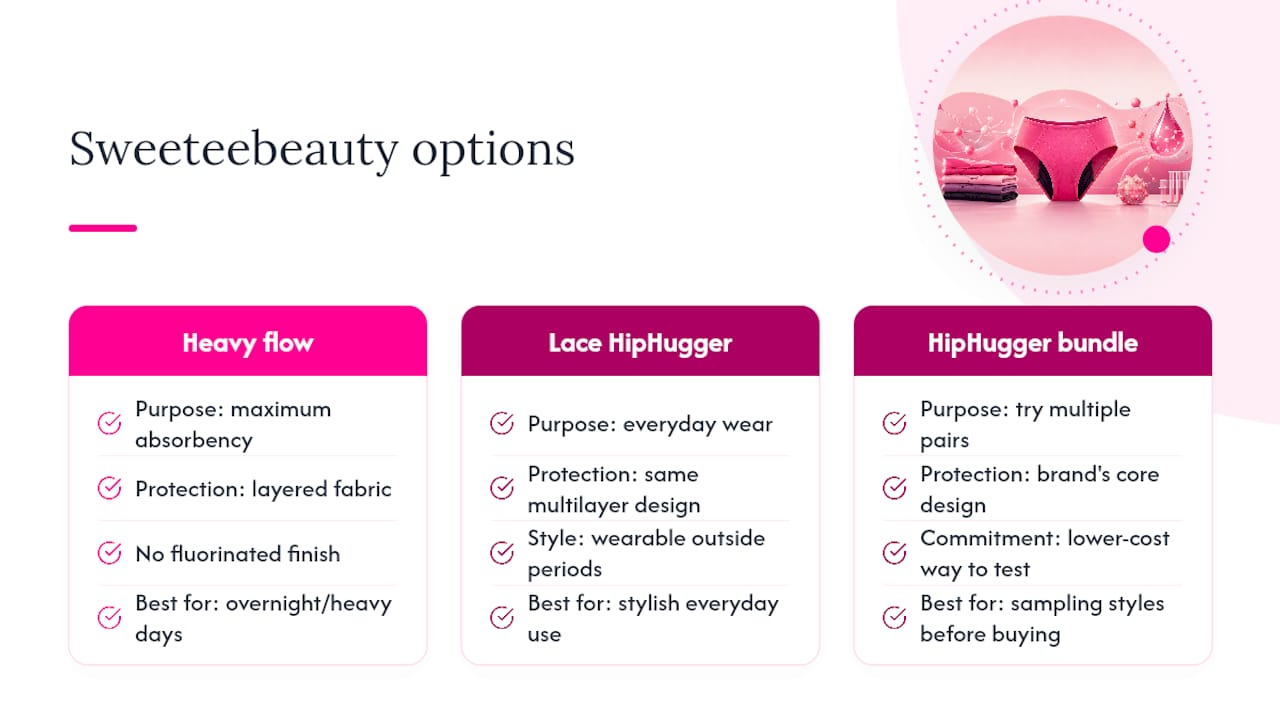
Sweeteebeauty designs its underwear around one goal: stopping leaks through layered fabric construction rather than a fluorinated finish. If heavy flow days or overnight protection are your main concern, the heavy flow protection collection is built specifically for maximum absorbency without added stain-resistant chemicals.
For everyday wear with a bit more style, the Lace HipHugger period underwear pairs the same multilayer protection with a fit you’d actually want to wear outside of period days. Want to test a few styles before committing to a full rotation? The HipHugger bundle is a lower-commitment way to try the brand’s core design across multiple pairs.
Have questions about materials or want testing documentation? Reach out through Sweeteebeauty before you buy. Sound purchasing decisions start with a straight answer, and that’s a standard worth holding every period product brand to.
This article is general information, not a substitute for advice from a qualified doctor. Consult a qualified healthcare professional about your own circumstances before acting on anything here.
Sources
- Our current understanding of the human health and environmental risks of PFAS | US EPA
- Scientists find PFAS in feminine hygiene products | University of Notre Dame
- Research Update: PFAS found in several reusable period products | American Chemical Society
- We Had 44 Period and Incontinence Products Tested for Forever Chemicals. Many Were Contaminated. | Wirecutter


