
Stop Feeling Wet in Period Underwear: Gusset Checks and Washing Tips

Quality period underwear should not feel wet against your skin. The top layer is built to move moisture away, not hold it there. The exceptions are predictable: you have hit the capacity of the absorbent core, the fit has shifted, or what you are feeling is sweat, not menstrual fluid. Check the gusset and swap to a heavier pair if your flow is heavy that day.
TL;DR:
- Most period underwear provides a moisture-wicking top layer that stays dry during wear, with dampness only occurring when the absorbent core reaches capacity or due to fit issues.
- A proper fit with a snug gusset and correct absorbency level matching your flow prevents pooling, leaks, and the wet feeling during use.
- Selecting the right absorbency—light, moderate, heavy, or overnight—based on tampon equivalents ensures comfort and reduces the chance of feeling damp.
- Proper washing and air drying extend the lifespan of the moisture-wicking layers, maintaining dryness and preventing early wear.
- Rotating between different absorbency levels during your cycle and checking your underwear regularly helps avoid the misconception that the product is defective when it feels damp.
Table of Contents
- Why Period Underwear Feel Wet Less Than You Think They Would
- What Causes That Wet Feeling During Wear?
- How to Pick the Right Fit and Absorbency for Your Flow
- How Long Can You Wear Period Underwear Before It Feels Wet?
- Washing Period Underwear Without Ruining the Wicking Layer
- What SweeTee Beauty’s Multilayer Design Means for How It Feels
- The Wet Feeling Isn’t the Real Problem, Your Habits Are
- Ready to Stop Wondering If You’ll Feel Wet?
- Sources
Why Period Underwear Feel Wet Less Than You Think They Would
Most people picture period underwear as a padded diaper. That is not how the good ones work. A well-made pair uses three distinct layers, and each one has a single job.
The top layer, the part touching your skin, is built to wick. It pulls moisture through itself and passes it down to the next layer rather than absorbing and holding it against you. Bamboo viscose and similar fabrics are common choices here because they’re breathable and move liquid fast, and bamboo viscose also carries natural antibacterial properties that help with odor control. Cotton can do a similar job, but it tends to hold onto moisture longer, which is why an all-cotton gusset sometimes feels damp sooner than a treated synthetic blend.
Below that sits the absorbent core, the workhorse layer that actually traps the fluid. Beneath that is a leakproof backing that stops anything from soaking through to your clothes. The wicking action itself relies on capillary movement, similar to how a paper towel pulls up a spill, and better designs use microchannel fabrics that keep working even after repeated washing.
Independent testing groups translate absorbency into terms most people already understand: tampon-equivalent ranges, so a “moderate” pair might hold what two to three regular tampons absorb over several hours. When you’re shopping, look for three things on the product page:
- Absorbency level (light, moderate, heavy, or overnight)
- Top-layer material (bamboo viscose, modal, or a wicking synthetic blend)
- Wash and care instructions specific to that fabric
What Causes That Wet Feeling During Wear?
When the sensation does show up, it almost always traces back to one of a few causes. Figuring out which one is happening takes less than a minute.
- Capacity reached. The core has absorbed as much as it can, so fluid backs up toward the top layer. You’ll notice a damp gusset, a heavier feeling than usual, or visible staining near the edges.
- Fit problems. A thong-style pair that’s slipping, or a size that’s too big for your hips, lets fluid pool instead of spreading across the absorbent zone. A snug, correctly sized gusset distributes fluid evenly and prevents that pooling.
- Sweat, not blood. Humidity or a hot day can leave you feeling damp in a way that has nothing to do with your period. Sweat spreads more evenly and lacks the texture or smell of menstrual fluid, and it usually shows up on the outer edges rather than concentrated at the center.
One thing that trips people up: you may notice moisture only when you pull your underwear down, even though the top layer felt completely dry while you were wearing it. That’s normal. It just means the core did its job and caught the fluid before it ever reached your skin.
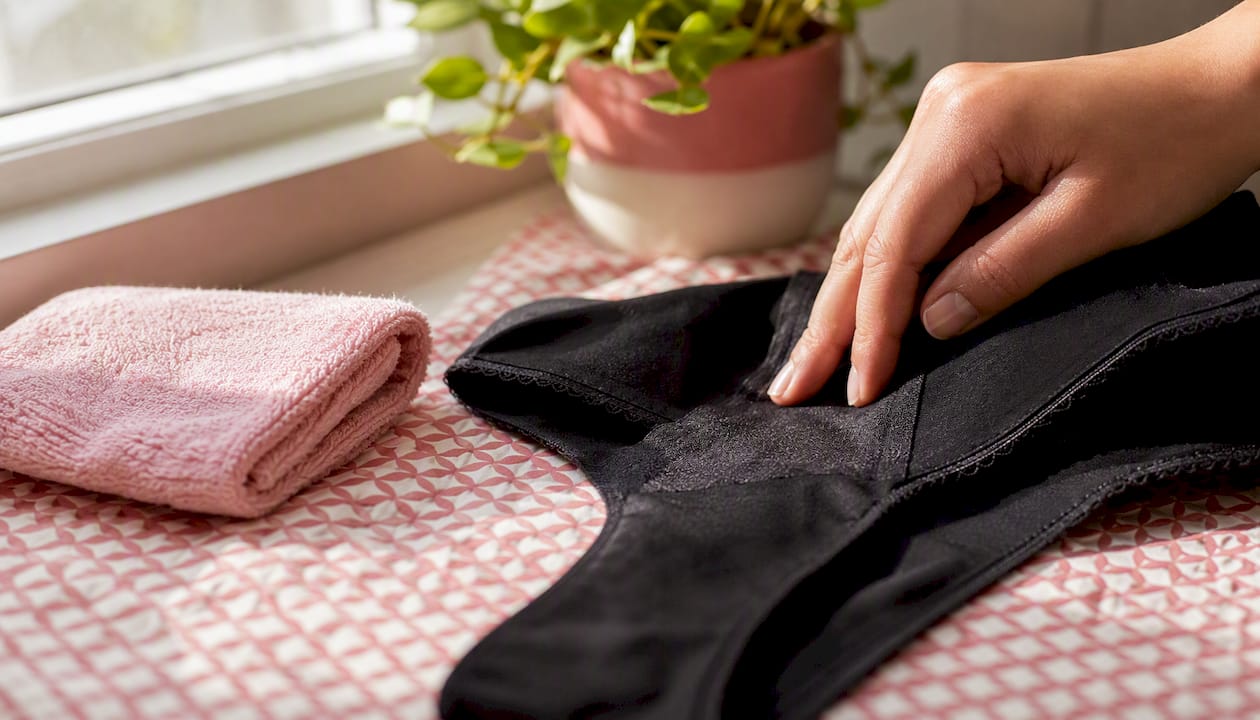
Pro Tip: Press two fingers flat against the gusset for a few seconds. If they come away dry, the top layer is doing its job. If they’re damp, it’s time to change.
How to Pick the Right Fit and Absorbency for Your Flow
Matching your underwear to your actual flow, not your heaviest day of the month, is where most people go wrong. Buying only one absorbency level and expecting it to cover everything sets you up to feel wet at some point.
A rough guide based on tampon-equivalent testing:
- Light flow: equivalent to 1 to 2 regular tampons, good for the tail end of your period or spotting days
- Moderate flow: equivalent to 2 to 3 tampons, suited for typical daytime wear
- Heavy flow: equivalent to 3 to 4+ tampons, built for your peak days or heavy-flow specific styles
- Overnight: extended capacity for 8 to 10 hours of horizontal wear, when fluid pools differently than it does standing up
For workouts, a high-waist or full-coverage style holds its position better than a thong. For sleep, size up slightly since you want room across the back panel where fluid tends to settle overnight. Whatever the style, prioritize a snug fit through the gusset and hips. A loose waistband is the single biggest reason people report shifting and leaking. If this is your first time buying, start with one heavier pair than you think you need. It doubles as backup on unpredictable days.
How Long Can You Wear Period Underwear Before It Feels Wet?
Most guides recommend changing period underwear every four to six hours, though the exact window depends on your flow and the pair’s absorbency rating. If it’s your first time wearing a particular style, treat that number as a ceiling, not a target, and check in earlier until you know how it performs on you specifically.
A few quick checks tell you when it’s time:
- Feel the gusset from the outside; any dampness means the core is getting close to full
- Look for staining creeping toward the edges of the absorbent panel
- Notice if the underwear suddenly feels heavier than it did an hour ago
For overnight wear, use a style rated specifically for extended hours rather than stretching a daytime pair past its limit. If your flow swings unpredictably between light and heavy, pairing period underwear with a backup product on your heaviest days is a reasonable safety net until you know your pattern.
Washing Period Underwear Without Ruining the Wicking Layer
How you wash period underwear determines how long the dry feeling lasts. Skip a step here and even the best pair starts feeling damp sooner than it should.
Rinsing in cold water right after wearing, before the fluid sets into the fabric, makes the full wash more effective. Storing a worn pair in a wet bag until laundry day works too, as long as you don’t let it sit for days.
- Rinse in cold water immediately after wear
- Machine wash on a cool cycle with a mild detergent
- Skip fabric softener entirely, since it coats fibers and blocks the wicking action
- Skip bleach and high heat, both of which break down the moisture-wicking treatment over time
- Air dry instead of tumble drying to protect the layers
Once a pair no longer feels dry within the first hour or two of wear despite proper washing, that’s the sign its absorbent core has worn down and it’s time to retire it.
What SweeTee Beauty’s Multilayer Design Means for How It Feels
SweeTee Beauty builds its period underwear around the same three-layer principle covered above, and applies it across absorbency levels from light through heavy and postpartum. The top layer is designed to stay dry against skin, the core is rated by absorbency level rather than a single one-size claim, and the leakproof backing is meant to hold regardless of activity level.
In practice, that means the top layer should feel no different than regular underwear during normal wear, the core has a defined capacity you can plan around, and the backing is the last line of defense if the core fills up before you change. Here’s a quick reference for what to expect at each level:
| Absorbency Level | Best Suited For | Expected Feel |
|---|---|---|
| Light | Spotting, tail-end days | Dry throughout typical wear |
| Moderate | Standard daytime flow | Dry with a normal change interval |
| Heavy | Peak flow days, heavy-flow styles | Dry with earlier check-ins recommended |
SweeTee Beauty also builds its underwear to be reusable and eco-friendly, which lines up with the same care routine outlined above: cold rinse, gentle wash, air dry.
The Wet Feeling Isn’t the Real Problem, Your Habits Are
The industry talks a lot about fabric science and not nearly enough about how people actually use these products day to day. That’s the gap worth naming. Most complaints about period underwear feeling wet don’t trace back to a defective product. They trace back to someone wearing one pair, one absorbency level, for an entire cycle and expecting uniform performance from a body that isn’t uniform.
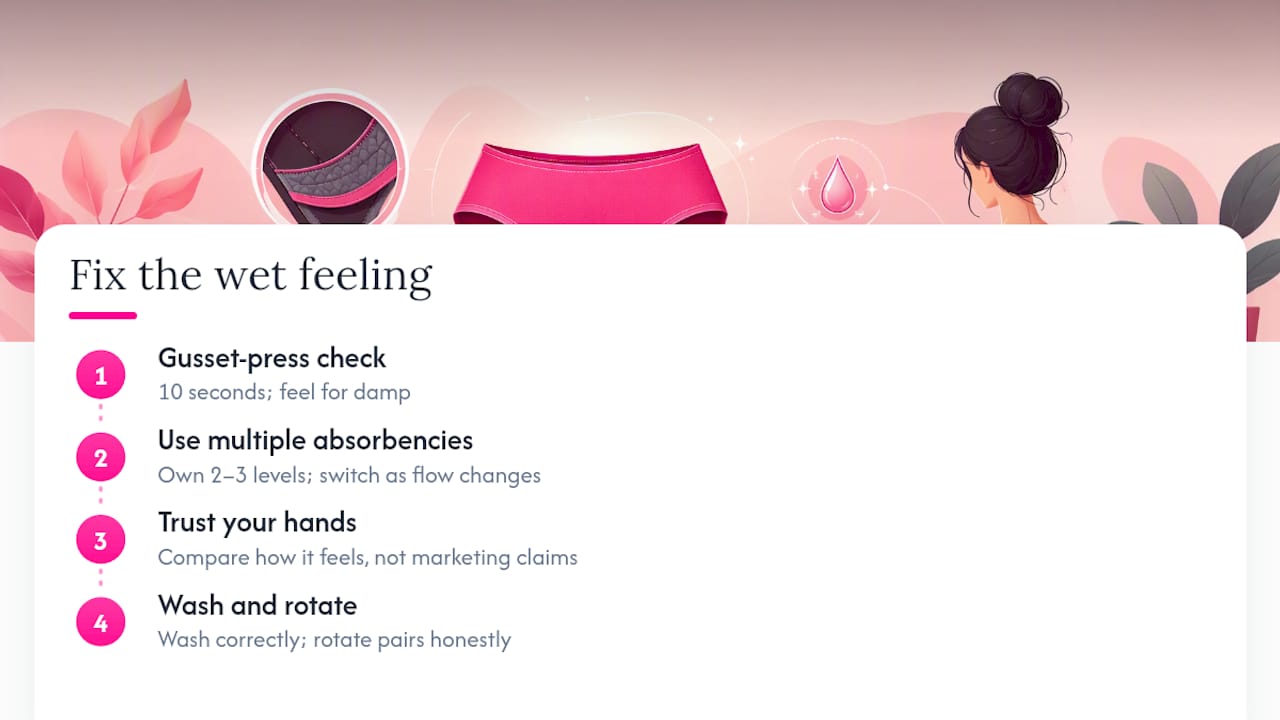
Conventional advice treats absorbency choice as a one-time decision. It isn’t. Your flow changes day to day, sometimes hour to hour, and the underwear that felt perfectly dry on day two can feel damp by hour five on day three. The fix isn’t a better fabric. It’s owning two or three absorbency levels and switching between them the way you’d switch tampon sizes.
The other habit people skip: the gusset-press check. It takes ten seconds and tells you more than any marketing claim about “12 hour protection” ever will. Trust your own hands over a package label, wash correctly, and rotate absorbency levels honestly. That combination solves the wet-feeling problem far more reliably than any single product does on its own.
— Tiera
Ready to Stop Wondering If You’ll Feel Wet?
If you’ve made it this far, you already understand more about wicking layers and absorbency ratings than most shoppers do standing in a store aisle. Sweeteebeauty builds directly on those same principles, with absorbency levels running from light through heavy and postpartum, so you’re matching a pair to your actual flow instead of guessing.
The full period underwear collection covers seamless and high-waist styles for daily wear, while the heavy-flow protection line is built for peak days when a lighter pair won’t hold. First-time buyers often start with the variety bundle so they can test more than one absorbency level in the same order, the same approach recommended earlier for figuring out what actually fits your cycle. Pick your absorbency level and order a pair today.
Sources
- How Does Period Underwear Work? – Boody US
- Solving the “Wet Feeling”: The Science of Instant-Dry Top Layers | Period Factory
- The 14 Best Period Underwear of 2026, Tested and Reviewed | InStyle


